Our internal AI agent for expenses: Bonbonnetje 🍬
Bonbonnetje is an AI Agent running in production on Agent Platform helping Xebians submit expense claims. Bonbonnetje is in active use by multiple internal departments and successfully completes hundreds of submissions monthly, helping save both employees and back-office valuable time.
Fine-tuning LLMs yourself
Fine-tuning can be a powerful way to specialised Large Language Models (LLMs). With open source models readily available, it is now also possible to fine-tune yourself. Read along to find out how.
The GenAI automation potential of data extraction
GenAI has been around for a little while and its capabilities are expanding quickly. But still, many companies fail to generate actual value with GenAI. Why is that? In this blogpost, we explore the GenAI automation potential that exists today for data extraction.
The Levels of RAG
LLM’s can be supercharged using a technique called RAG, allowing us to overcome dealbreaker problems like hallucinations or no access to internal data. But what can we expect from RAG? What use cases work well and which are more challenging? Let’s find out together!
PyData Eindhoven 2024
Eindhoven, The Netherlands —
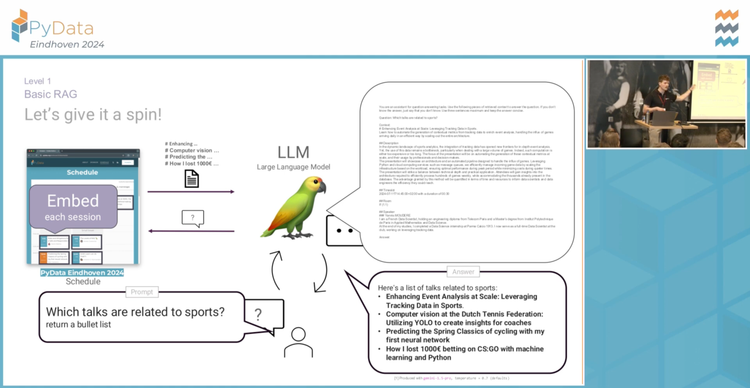
Retrieval Augmented Generation (RAG) is powerful. Let's go from Basic (chunking, vector embeddings, nearest-neighbor search) to Hybrid Search (TF-IDF, BM-25 and Reciprocal Rank Fusion) to Advanced (PDF parsing, tables, graphs) and finally, the cutting edge: Multimodal.
AI Community Day 2024
Utrecht, The Netherlands —
LLMOps on Azure: scaling RAG applications, using Azure AI Search (keyword and vector search, reciprocal rank fusion), hosting LLM apps on Azure Container Apps, IaC with Terraform, robust CI/CD setups and an elaborate observability stack with Langfuse/OpenTelemetry.
RAG on GCP: production-ready GenAI on Google Cloud Platform
GCP has an increasing set of managed services that can help you build production-ready Retrieval Augmented Generation (RAG) applications. How can you best leverage them to build RAG applications? Let’s explore together. Read along!
Dataset enrichment using LLM’s ✨
Large Language Models (LLM's) have proven to be useful for numerous tasks. LLM's can summarise text, generate text, classify text or translate text. What LLM's can also be used for is converting unstructured data to structured data.
PyData Eindhoven 2023
Eindhoven, The Netherlands —
LLM data extraction: prompt engineering, JSON output modes, Function calling, Pydantic schemas, evaluation and a GPT 3.5 vs GPT 4 vs PaLM showdown.
GoDataFest 2023
Amsterdam, The Netherlands —
How can we extract more value from data by using what LLMs can offer us? Previously impossible data extractions can be now done and a new level of data quality and direct filtering can now be realized.
DataMass Gdańsk Summit 2023
Gdańsk, Poland —
Enriching datasets with LLMs: JSON output modes, schema definitions with Pydantic, evaluating structured data extraction, Function Calling.
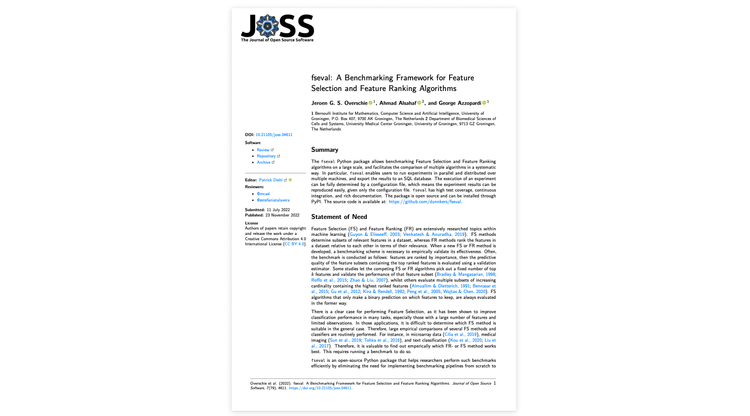
fseval: A Benchmarking Framework for Feature Selection and Feature Ranking Algorithms
Journal of Open Source Software — A Python package for benchmarking Feature Selection and Feature Ranking algorithms at scale: parallel and distributed experiments, fully reproducible from a config file, with results exported to SQL.
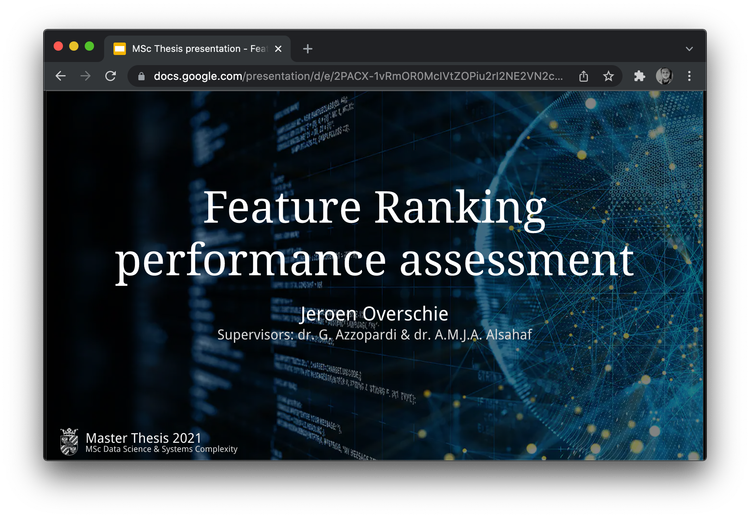
A novel evaluation methodology for supervised Feature Ranking algorithms
arXiv — A new, systematic evaluation methodology for Feature Rankers using synthetic datasets with known feature importances, and a large-scale benchmark run with fseval on an HPC cluster.
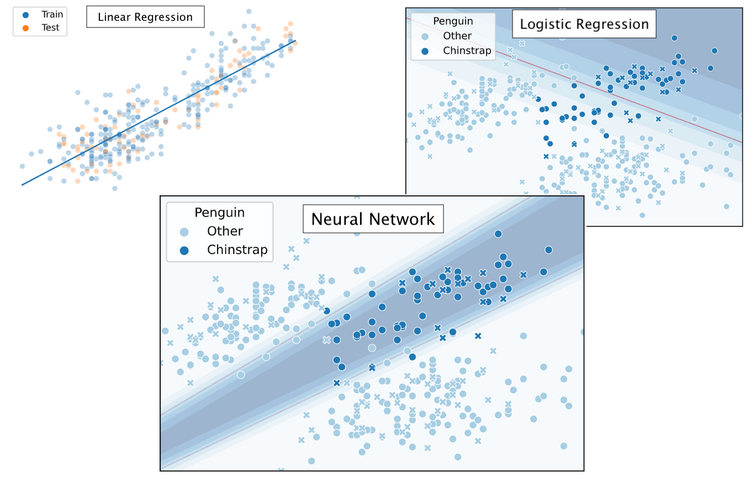
From Linear Regression to Neural Networks
How are linear regression, logistic regression and neural networks related? What is overfitting and how do we fight it? In this post, we find answers to these questions in an interactive way by working with a real-world dataset on penguins.
Making Art with Generative Adversarial Networks
Can computers make art? To find out, we tried ourselves. We used Generative Adversarial Networks to try to paint new Van Gogh paintings.