Musical Key Recognition using a Hidden Markov Model

Underlying every musical piece is its key. It determines the group of sound pitches that are used, and tells really a lot about its sound. Among others, it's useful for DJ's, who can benefit from selecting tracks that have similar key, so the sound matches nicely. Now, in this project, we took on the challenge of trying to train a model to predict such a key. Let's see how we did this.
Intuition
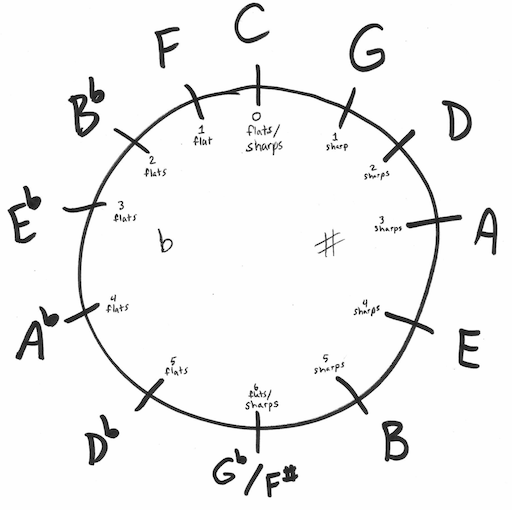
First of all, we must know there are 24 keys, 12 in major and 12 in minor. They can be illustrated like so:
Now, we chose Hidden Markov Models (HMMs) as our main instrument to try to predict the correct musical key, given a set of Chroma vectors. Such vectors represent the relative strength of each pitch in different segments of the track, which data we have for about 10,000 tracks. We obtain such Chroma vectors using Spotify's web API, which additionally gives us a ground-truth indication of the actual music key, such that we can use supervised learning to train our HMM.
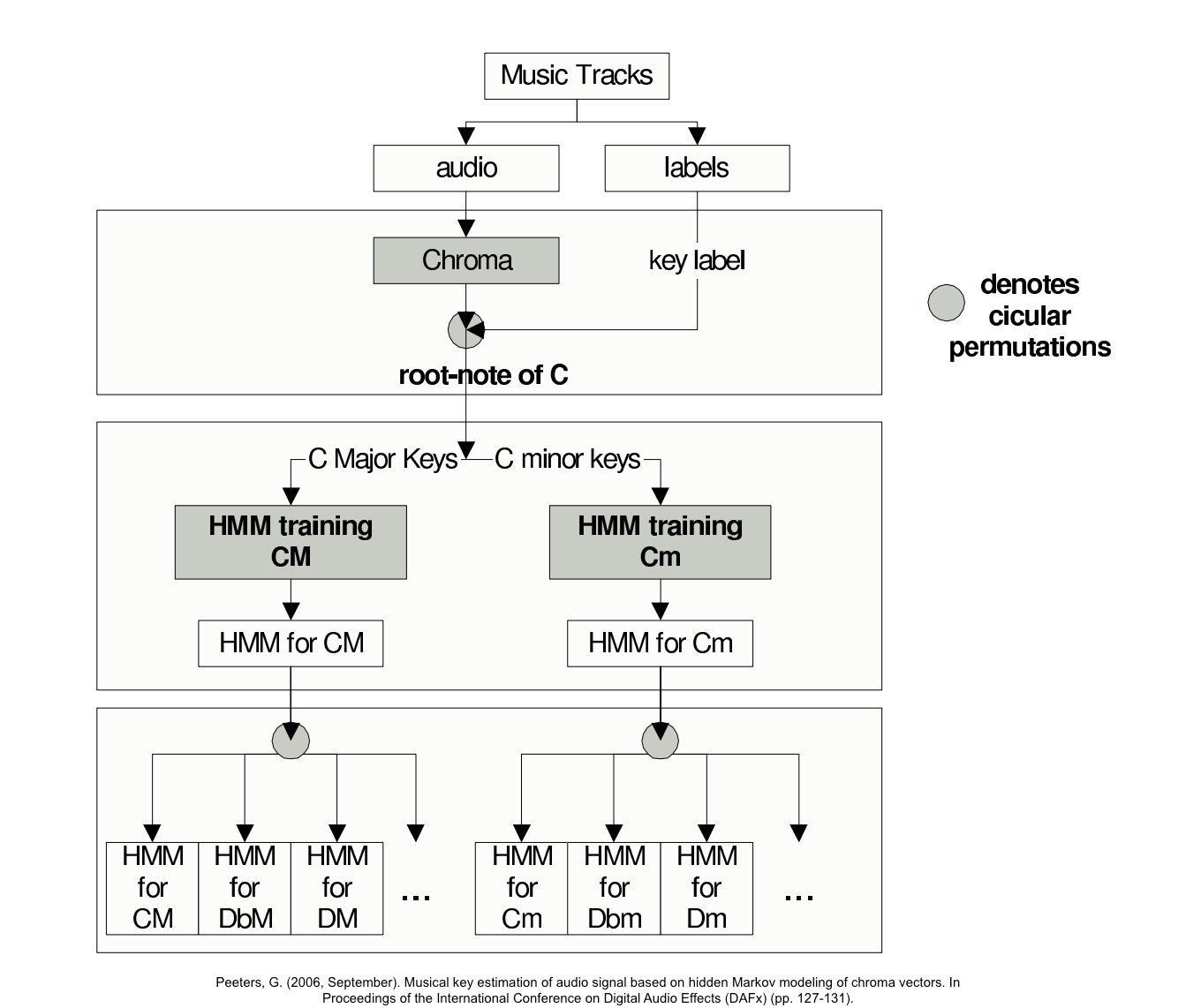
The key insight is to train an HMM for both major and minor, separately. Then, we create copies of those models and retrain them with a circular shift in its key. In this way, we train a model for every key: such, we can predict the probability of a song belonging to a certain key, by searching for the model assigning the highest probability to its output. The process can be illustrated as follows:
Execution
The actual implementation of the code and project can be found on GitHub: